Spanish NGO ‘Open Arms’ Arrives in Havana With a Donation for a Pediatric Hospital

The activists are delivering solar panels, backup batteries, and medical supplies financed with more than €160,000 raised through self-managed donations from over 4,000 donors.

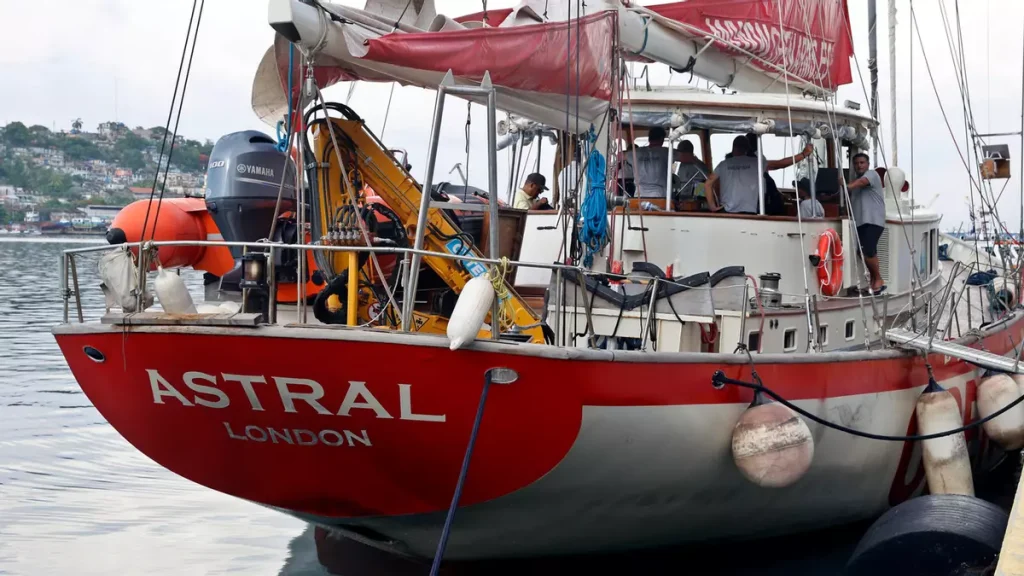
The ‘Astral’ arrived in Havana this Sunday, and the activists who were traveling on it will be at the Juan Manuel Márquez hospital this Monday. / EFE

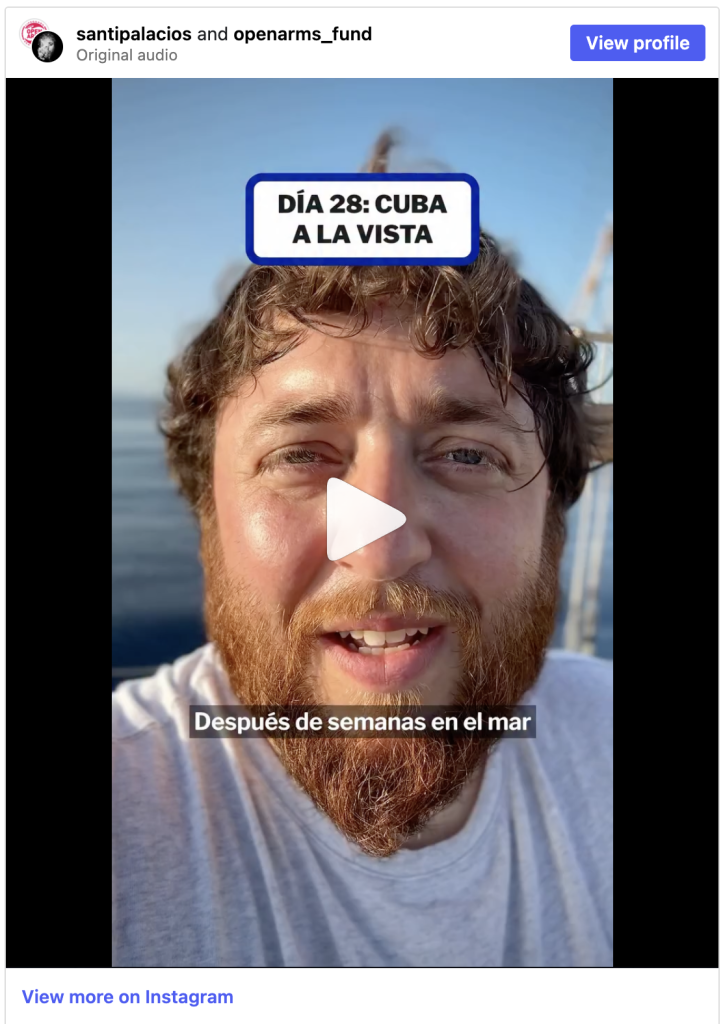
14ymedio bigger14ymedio / EFE, Havana, July 20, 2026 – The sailing vessel Astral, operated by the Spanish NGO Open Arms, which together with more than 150 social and political organizations launched the “Rumbo a Cuba” initiative, arrived Sunday at the Port of Havana carrying seven tons of humanitarian aid destined for a children’s hospital in the Cuban capital.

The Open Arms vessel departed Barcelona in May and traveled 6,200 miles to transport a shipment of solar panels, backup batteries, and medical supplies to Cuba, financed with more than €160,000 raised through self-managed donations from over 4,000 donors.

The donation is intended to provide energy independence for the Intensive Care Unit (ICU), intermediate care unit, and clinical laboratory of Havana’s Juan Manuel Márquez Pediatric Hospital.

At the ceremony welcoming the humanitarian mission, Óscar Camps, founder and director of the NGO Proactiva Open Arms, told the press that the initiative “is a humble contribution made by the organization with the support of the Spanish people” to highlight the humanitarian impact of the United States embargo on the Caribbean nation.

Click here to watch video

Camps congratulated the Cuban people, saying, “You are enduring and resisting an inhumane blockade. You are the true heroes, and the message I bring from my country to the Cuban people is that you are not alone, that this is continue reading

only the beginning, and we hope others will follow this example.”

“We are living through a very difficult moment because of a blatant violation of international law, human rights, and international agreements,” Camps said, referring to what he described as the energy blockade imposed by the United States on the Island.

The Catalan activist also called for “bringing greater visibility to the problems Cuba is facing” and expressed confidence that doing so “will generate sympathetic support from other organizations that will want to collaborate and do the same” as Open Arms.

In that regard, he noted that his autonomous community, Catalonia, has allocated half a million euros to organizations working in Cuba “after we launched our mission.”

“It has already been worthwhile. We have contributed a tiny drop, a grain of sand, in an effort to repay the solidarity we have always received from the Cuban people,” he added.

The delegation participating in the Rumbo a Cuba humanitarian mission includes several Members of the European Parliament: Miguel Urbán Crespo, co-founder of the Podemos Party; Ana Miranda of the Galician Nationalist Bloc; Su Moreno of the Popular Unity Candidacy; and Aída Llauradó of Comuns. They took part last Saturday in an event at the Casa de las Américas cultural institution.

On Monday, the organizers of Rumbo a Cuba are scheduled to visit the hospital benefiting from the initiative, as well as participate in an activity with children at a cultural center in the Cuban capital.

Last March, the Island received the Nuestra América Convoy, a flotilla that sailed from Mexico carrying 14 tons of food, medicine, and solar panels.

Translated by Regina Anavy

______________________

COLLABORATE WITH OUR WORK: The 14ymedio team is committed to practicing serious journalism that reflects Cuba’s reality in all its depth. Thank you for joining us on this long journey. We invite you to continue supporting us by becoming a member of 14ymedio now</

Economists Estimate Cuba Will Need Three Years to Complete an “Emergency Stabilization”

  • Cuba Transformación calls for political changes to transform the country into a social market economy supported by a democratic state governed by the rule of law.
  • Negotiations with the United States are essential, they say, to achieve a relaxation of sanctions.
The economists call for support for small and medium-sized private enterprises (mipymes) as engines of investment, innovation, and job creation. / 14ymedio

14ymedio bigger14ymedio, Madrid, July 20, 2026 – Cuba Transformación believes that an initial phase of “stabilization and emergency” aimed at “halting macroeconomic deterioration,” addressing the energy crisis, and reviving agriculture and tourism will take approximately three years. The working group, announced last June and made up of five independent Cuban experts tasked with developing a proposal for economic transformation, considers it “essential” that, before any viable plan can begin, negotiations take place through which the United States eases sanctions, since their continuation, they argue, “constitutes one of the main obstacles to recovery.”

The document is 120 pages long, although the specialists—Mauricio De Miranda, Omar Everleny Pérez, Ricardo Torres, and Pavel Vidal, all critics of the current regime, although Vidal is also among the experts consulted by Díaz-Canel—have prepared a 19-page executive summary outlining its main principles. In the introduction, the text makes clear that it is neither a response to nor a complement of the 176 measures presented by the Cuban government, but rather its own methodology and sequence of reforms. Its premise is clear: Cuba should become a social market economy supported by a democratic state governed by the rule of law, including multiparty elections, freedom of association, freedom of the press and expression, transparency, and the subordination of state powers to the law.

Furthermore, the transformation must be “conceived, led, and carried out by Cubans themselves, in the national interest” and in order to avoid the loss of sovereignty. However, the exile community will play a fundamental role, they argue, not only because of its Cuban identity but also because of its experience, networks, and capital. Another essential component will be the international community, which they urge to create an assistance fund that would be crucial in ensuring that the enormous initial costs of rebuilding a currently decapitalized system do not fall on the population, especially its most vulnerable sectors. continue reading

Another essential component will be the international community, which they urge to create an assistance fund that would be crucial in ensuring that the enormous initial costs of rebuilding a currently decapitalized system do not fall on the population

The document insists that, at present, the suspension of fuel shipments from Venezuela and the threat of sanctions against both countries that might sell hydrocarbons to Cuba and companies that do business with the regime are preventing recovery. That does not mean, however, that responsibility is attributed solely to the United States. The economists argue that the current crisis “is not a temporary phenomenon nor can it be explained exclusively by recent external shocks.” Instead, those shocks have had such a profound impact because they struck “an economy that had already accumulated structural weaknesses, limited adjustment capacity, and long-postponed reforms.”

The experts also warn that the situation is becoming more complicated in every respect, including Cuba’s de facto dependence on the United States—not at the state level, but because remittances largely originate there. In the experts’ view, money and shipments from relatives have become the equivalent of the support once provided first by the Soviet Union and later by Venezuela.

The document also states that reality has already imposed part of the adjustment. “The State has, in real terms, reduced its ability to finance public goods, investment, social services, and subsidies, while inflation and currency depreciation have severely eroded purchasing power.” Furthermore, “there has been a growing de facto commercialization of essential services. In this context, poverty ceases to be a residual phenomenon and becomes a structural feature of Cuban social reality,” it adds.

In response, the proposal should be divided into three phases, although the current document addresses only the first: stabilization and emergency. The other two phases, expected after the initial three-year period, are “reactivation and institutional development,” focused on structural reforms to increase competitiveness, improve resource allocation, restore financial credibility, and to implement “model consolidation,” aimed at defining the social contract and the medium- and long-term development strategy.

For now, the priority is to begin the first phase, which requires at least six priority areas detailed in the document. The first concerns macroeconomics and prices. Its key proposals include integrating all State entities, including Gaesa, into the civilian fiscal system and unifying the exchange rate market where three vastly different rates currently coexist, only one of which remotely reflects reality, under a managed floating system overseen by a Central Bank of Cuba that performs the functions appropriate to such an institution rather than merely implementing the regime’s directives. It also calls for price liberalization, the elimination of price caps, and updated wages and pensions. In addition, it proposes eliminating automatic subsidies and focusing assistance on vulnerable populations. It also suggests creating a stabilization fund to channel external resources and proceeds from asset sales. Transparency, especially in the national budget, is considered indispensable.

Regarding energy, the second area on the list and a top priority, the experts urgently call for contracting floating power plants and restoring thermoelectric plants. They also propose accelerating solar energy projects with storage capacity, approving new electricity rates, improving the quality of the domestic crude oil used in thermal plants, and opening the fuel import, distribution, and marketing market under a regulated framework.

Regarding energy, the second area on the list and a top priority, the experts urgently call for contracting floating power plants and restoring thermoelectric plants. They also propose accelerating solar energy projects with storage capacity and approving new electricity rates

Agriculture and tourism are also included in this phase. Among the priority objectives are eliminating the state procurement system and replacing it with voluntary contracts at market prices, allowing private participation in the agricultural sector—a measure that apparently has already been approved—and creating a market for buying, selling, and leasing farmland. The document calls for tax and tariff incentives to encourage investment in agricultural infrastructure and greater digitalization of agricultural marketing. It also considers it necessary to guarantee a stable energy supply to tourist destinations, strengthen their ties with local producers, and reposition the Cuba brand.

Regarding property rights and business transformation, the proposal calls for eliminating obstacles to the growth of small and medium-sized private enterprises (mipymes), with tax incentives to encourage expansion. At the same time, it recommends breaking up the military conglomerate Gaesa by transferring its companies, assets, and foreign currency holdings to civilian institutions and the Central Bank, while closing or restructuring unviable state-owned enterprises and creating “transparent” privatization processes.

The fifth section addresses “external integration.” It calls for eliminating the state’s monopoly on foreign trade, a measure already contemplated by the regime, formally applying for Cuba’s membership in the principal international financial institutions, restructuring the country’s foreign debt, and beginning bilateral negotiations to resolve claims related to the property confiscations of the 1960s.

Finally, the document also focuses on “social protection and governance.” In this section, it considers it essential to establish a protection package to cushion the effects of labor market adjustment and to audit the program using mandatory social indicators. It also proposes reforming the Labor Code by recognizing diverse forms of property ownership, freedom of association for labor unions, and the right to strike. In addition, it calls for decentralizing fiscal authority and enforcing “strict anti-corruption frameworks.”

All of these measures, along with many others, should be implemented sequentially. While some, the authors note, can be introduced simultaneously, others require that certain reforms precede the rest.

The document concludes by calling on the international community for assistance and support, as well as inviting other experts to contribute to proposals that the authors do not consider final. “The strategic objective of this process is the construction of a social market economy within the framework of a democratic state governed by the rule of law. Expanding the role of the market and private initiative does not weaken the State, but rather redefines and strengthens its capabilities,” they conclude.

Translated by Regina Anavy
______________________

COLLABORATE WITH OUR WORK: The 14ymedio team is committed to practicing serious journalism that reflects Cuba’s reality in all its depth. Thank you for joining us on this long journey. We invite you to continue supporting us by becoming a member of 14ymedio now. Together we can continue transforming journalism in Cuba.

Cubans in the MLB All-Star Game: Stories of Boats, Escapes, and Exile

The votes these Cubans received for the so-called All-Star Game were no coincidence. Each of them put up the numbers necessary to earn a place in Philadelphia.

Miguel Vargas decided to leave with his father, Lázaro Vargas, when he was 16 years old. / Chicago White Sox

14ymedio bigger14ymedio, Andy Lans, Matanzas, July 20, 2026 – Yordan Álvarez left Cuba and established residency in Haiti. Randy Arozarena boarded a boat from Pinar del Río to Mexico. Yandy Díaz also left by boat, traveling from Holguín to the Dominican Republic. Aroldis Chapman defected from Team Cuba while the team was in Rotterdam, Netherlands, and Andy Pagés completed a route through Guyana, Curaçao, and Haiti before arriving in the Dominican Republic.

Raisel Iglesias managed to leave the Island more than a decade ago after a failed attempt, while Miguel Vargas decided to leave with his father, Lázaro Vargas, when he was 16 years old. The father of Sal Stewart Jr. and the mother and paternal grandparents of Nick Martínez also left Cuba. All of them, on the grass at Philadelphia’s Citizens Bank Park, represented the Cuban exile community at the 96th Major League Baseball (MLB) All-Star Game.

The game, held on July 14, ended with a 4-0 victory for the American League over the National League

The game, held on July 14, ended with a 4-0 victory for the American League over the National League. The standout offensive performances by the Cuban players were hits from Yordan and Randy, along with a tremendous home run by Miguel Vargas in the eighth inning. Pitchers Nick Martínez and Raisel Iglesias each retired one inning, while Aroldis Chapman recorded two outs, one of them by strikeout.

The votes these Cubans received for the so-called All-Star Game were no coincidence. Each of them put up the numbers necessary to earn a place in Philadelphia. Most ranked among the league’s statistical leaders before the All-Star break.

Yordan Álvarez stood out with the Houston Astros. He led all of MLB in continue reading

slugging percentage (.633), on-base percentage (.426), and OPS (1.059), while ranking second in home runs (31) and RBIs (71), and fourth in batting average (.318). Those last three figures positioned him to compete for the American League Triple Crown.

Yandy Díaz continued adding to his legacy with the Tampa Bay Rays. The veteran slugger, son of former second baseman Jorge “La Araña” Díaz, finished the first half leading the American League in batting average at .322. As if that were not enough, he ranked sixth in the league in hits with runners on base (53) and second in hits with runners in scoring position (30). He batted .393 with runners on base and .441 with runners in scoring position, demonstrating his ability to deliver in crucial moments.

Another Rays player, Nick Martínez, carried the tenth-best earned run average of the season at 2.65 over 105.1 innings. The Cuban-American right-hander had eight wins and two losses, 62 strikeouts, only 19 walks, and a 1.12 WHIP, proving that no matter how old the wind gets, it still blows.

It is not far-fetched that many analysts view Miguel Vargas as the most offensively gifted third baseman in Major League Baseball. Among players whose natural position is third base this season, the emerging Chicago White Sox star led in runs scored (64), walks (56), and extra-base hits (42). He also ranked second in doubles (20) and RBIs (59), and third in home runs (21) and stolen bases (11).

Meanwhile, Cuban-American Sal Stewart Jr. has set the standard among rookies by leading them in extra-base hits (41), RBIs (65), and doubles (22). The versatile Cincinnati Reds infielder has already become one of the leading candidates for the National League Rookie of the Year Award.

The versatile Cincinnati Reds infielder has already become one of the leading candidates for the National League Rookie of the Year Award

Randy Arozarena enjoyed another outstanding first half with the Seattle Mariners, combining power and speed. He demonstrated this by tallying 21 doubles, one triple, and 11 home runs, along with 19 stolen bases in 24 attempts. His .380 on-base percentage also highlighted his ability to reach base.

With a demanding franchise like the Los Angeles Dodgers, outfielder Andy Pagés has handled the pressure well. His 66 RBIs ranked seventh in all of Major League Baseball. Some of his most impressive achievements also came with runners on base. In those situations, he ranked third in MLB in home runs (13) and first in extra-base hits (25).

What more can be said about the ageless Aroldis Chapman and Raisel Iglesias? Both closers once again justified why they are the top two Cuban pitchers in career saves in the world’s premier baseball league. Chapman, pitching for the Boston Red Sox, became in 2026 the relief pitcher with the most strikeouts in MLB history, and arrived at Citizens Bank Park with 19 saves, an outstanding 2.20 ERA, and 36 strikeouts in 28.2 innings pitched. Meanwhile, Raisel recorded the same number of saves with the Atlanta Braves, posting a 2.23 ERA along with 36 strikeouts in 32.1 innings.

Translated by Regina Anavy

______________________

COLLABORATE WITH OUR WORK: The 14ymedio team is committed to practicing serious journalism that reflects Cuba’s reality in all its depth. Thank you for joining us on this long journey. We invite you to continue supporting us by becoming a member of 14ymedio now. Together we can continue transforming journalism in Cuba.

El Bahía, a Symbol of Matanzas, Fades Amid Padlocks and Blackouts

The iconic Peñas Altas recreational complex remains practically closed due to the energy crisis and poor state management

There, where orchestras once played and the buzz of young people mixed with the waves breaking against the rocks, faded railings now predominate. / 14ymedio

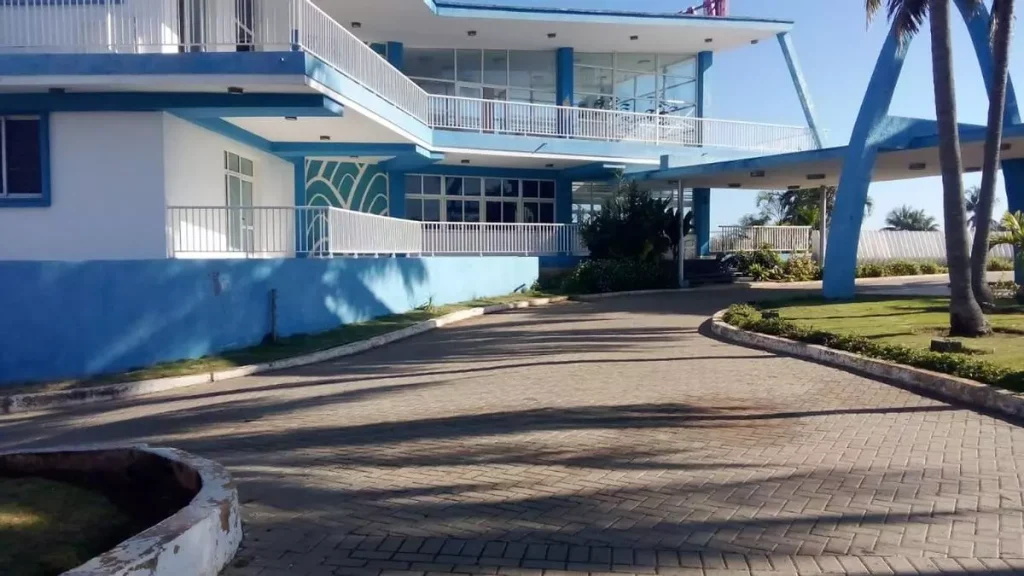
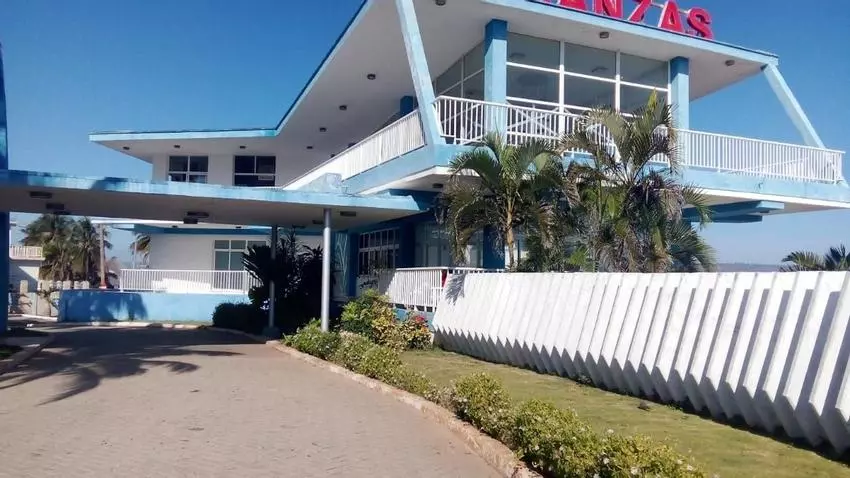
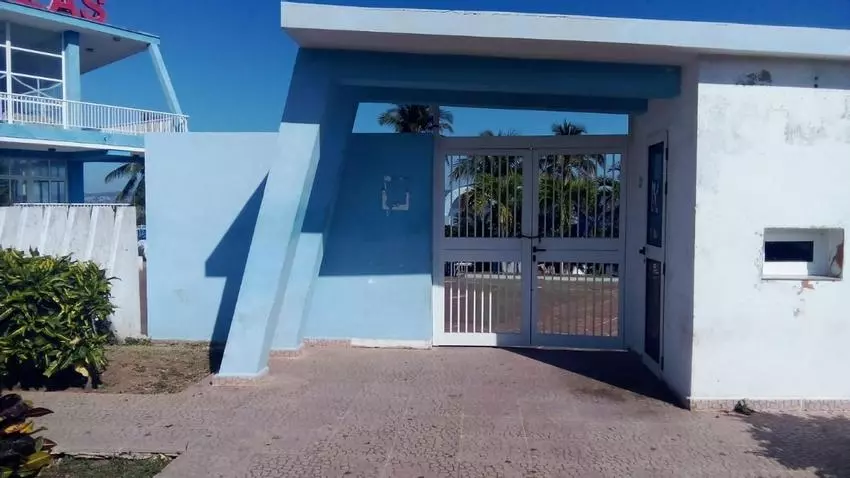
14ymedio bigger14ymedio, Julio César Contreras, Matanzas, 20 July 2026 / The highway enters Matanzas along the coast, and before the bridges and the city skyline come into view, a building with modern lines still catches the eye. Painted blue and white, with large windows and the name of Matanzas crowning the roof in huge red letters, the gastronomic and cultural complex El Bahía retains the elegance of another era. From a distance, the photos are deceiving: it looks like a place ready to welcome tourists and families. Get closer, though, and it becomes clear that much of that splendor has been left locked behind padlocked doors.

Located in Peñas Altas, right on the coastline, El Bahía is no ordinary restaurant for the people of Matanzas. For decades it was a gathering place for family celebrations, concerts, dance nights, and dinners with one of the best views of Matanzas Bay. Today, however, the picture has gone silent.

“It’s a shame that such a beautiful place stays closed practically every day of the week. It only operates when there’s power,” Horacio, a local resident who collects empty beer and soda cans to sell to the state as raw materials, tells 14ymedio.

“It’s a shame that such a beautiful place stays closed practically every day of the week. It only operates when there’s power”

The man, his skin weathered by sun and sea salt, recalls when on weekend nights it was hard to find a spot to park an almendrón [a classic American car used as a private taxi] nearby. “Now you can walk through here and all you hear is the sea,” he says, pointing toward the ranchón continue reading

and the old Las Terrazas cabaret.

There, where orchestras once played and the buzz of young people mixed with the waves breaking against the rocks, faded railings now predominate, weeds are growing across the outdoor areas, and a decline seems to be advancing faster than any recovery plan. “That whole area needs proper maintenance. If it keeps being neglected like this, it will end up costing twice as much to fix later. I think that before this keeps falling apart, the Provincial Lodging Company should lease it to someone willing to invest here,” Horacio suggests.

On the second floor, the restaurant El Mirador offered a privileged view of the bay. From its windows, diners could watch ships entering the port while they had lunch. For years, a meal service for vulnerable people also operated there.

Photo caption: Painted blue and white, with large windows and the name of Matanzas crowning the roof in huge red letters, the gastronomic and cultural complex El Bahía retains the elegance of another era / 14ymedio

“From Monday to Saturday they used to sell us a fairly decent meal for 20 pesos, but that’s stopped too,” Horacio laments. “They tell us they can’t cook because there’s no power or gas. The head chef assured me that lunches would come back once conditions improve, but I don’t put much faith in those promises anymore.”

The ongoing blackouts plaguing Cuba’s economy have ended up reaching even a place meant precisely for leisure. The energy crisis forces the site to close whenever there’s no electricity, but the problems go well beyond power outages.

A few steps away is another Matanzas resident, who for years worked cleaning the complex’s public restrooms. Today he sells pizzas for a private business.

“Especially on Saturdays, this place used to be packed until two or three in the morning,” the man recalls. “The electricity problem has hit us hard, but so has the lack of management. If people know they can come from downtown Matanzas and find the place closed or with nothing on offer, they simply stop coming.”

Both agree that the complex’s reputation has deteriorated at the same pace as its facilities.

Both agree that the complex’s reputation has deteriorated at the same pace as its facilities. “Word has already gotten around all of Matanzas that the El Faro bar almost never has a variety of drinks and that the cocktails aren’t made the way they used to be,” adds the former employee. “Anyone with money wants to spend it somewhere worthwhile, not come here to try their luck.”

The paradox is even greater because just a few years ago the complex seemed to be starting a recovery. In October 2023, a modern Ocio Club with virtual reality equipment and video games was inaugurated there, presented by the state press as one of the main new recreational attractions to celebrate the city’s 330th anniversary. Authorities said at the time that the project would expand entertainment options for children and young people and revitalize the property.

However, the momentum appears to have quickly run out. The building, which still retains an attractive architecture and a prime seafront location, depends – like so many other things in Cuba – on an electrical supply that almost never arrives and on promises of recovery that have taken far too long to become reality.

Translated by GH

______________________

COLLABORATE WITH OUR WORK: The 14ymedio team is committed to practicing serious journalism that reflects Cuba’s reality in all its depth. Thank you for joining us on this long journey. We invite you to continue supporting us by becoming a member of 14ymedio now. Together we can continue transforming journalism in Cuba.

At Least 97 Recruits Have Died During Military Service in Cuba Since 2001

An Ocac report reveals that suicide is the leading cause of death, with 33 cases, and warns of sentences of up to ten years for those who survive an attempt

Photo caption: Young people who try to evade military service can face sentences of up to five years in prison. / Luis Herrera/Escambray

14ymedio bigger14ymedio, Madrid, July 20, 2026 / At least 97 young people have died while performing Active Military Service (SMA) in Cuba between 2001 and 2026. The figure appears in a report from the Cuban Citizen Audit Observatory (Ocac) – an independent entity run by the think tank Cuba Siglo 21 – which also concludes that suicide is the leading cause of death among recruits and warns of an increasingly restrictive system, with little transparency and no mechanisms for accountability when a tragedy occurs.

According to the report published this Monday, drawn from a registry of cases verified by Archivo Cuba and independently cross-checked, of the 97 deaths of young recruits, 33 correspond to suicides, or 34% of the total. The report also notes an increase in reported suicides in recent years and highlights that 2025 was the year with the most cases: 22 – although the authors note that this increase may also reflect a greater ability to document and publicize these events.

The study stresses that these figures represent a documented minimum. The organization notes that the Cuban state does not publish official statistics on deaths during military service and states that there are dozens of additional cases still pending verification. Victims’ families frequently report contradictory official accounts, difficulties accessing forensic reports, and a lack of independent investigations that would reveal what actually happened.

The report also notes an increase in reported suicides in recent years and highlights that 2025 was the year with the most cases: 22

Of the 97 deaths reported since 2001, the report attributes 25 to “serious negligence,” 22 to accidents, six to lack of medical care, six to killings, two to disappearances, and in three other cases the cause of death could not be determined. In the 63 cases where age could be confirmed, the average is 18.7 years, and seven of the deceased were under 18. continue reading

Ocac also charges that, rather than seeking solutions to this alarming situation, Cuban law has toughened penalties against those who try to avoid military service. The law keeps service mandatory for men from age 17, requires registration starting at age 16, and expressly denies the right to conscientious objection. The Military Penal Code, passed in 2023, stiffened penalties for those who attempt to evade military service, with sentences of up to five years in prison, and also punishes self-harm, feigning illness, or falsifying medical documents to obtain a discharge.

The report further states that the Military Prosecutor’s Office can treat a suicide attempt as an act of desertion, with sentences exceeding ten years in prison for those who survive.

Testimonies gathered by the researchers describe extreme methods used to try to leave military service: self-inflicted wounds with weapons, swallowing sharp objects, machete wounds to the ankles and knees, or deliberately caused fractures. Several former recruits said that, for many young people, self-harm ends up being the only way out of a system they describe as oppressive and degrading. When that path doesn’t work either, the report adds, some come to see suicide as the only way out.

The Military Prosecutor’s Office can treat a suicide attempt as an act of desertion, with sentences exceeding ten years in prison for those who survive

The document argues that Cuba’s legal framework conflicts with several international commitments taken on by Havana, including the Convention on the Rights of the Child and International Labour Organization conventions, by allowing the enlistment of minors under 18 and the use of recruits for agricultural, construction, or guard duties that, according to the authors, go beyond the strictly military nature of the service.

Ocac also warns of repeated reports of young people sent into military service despite suffering from psychological problems or illnesses incompatible with handling weapons. As an example, it cites the case of Dailier Rodríguez Tamayo, a 19-year-old who died in March of this year at a military unit in El Cotorro, Havana. The recruit had a ruling from the Naval Hospital advising against his carrying weapons due to his mental health, but he remained assigned to the unit regardless.

Another point the report highlights is the opacity surrounding recruits’ deaths, as in the case reported by Mercedes Roque, mother of Antonio Alejandro Rossi Roque, another young man who died during military service under circumstances that have still not been clarified. The woman blamed the unit’s commanders and said that “they all keep covering for each other,” while she continues to wait for a convincing explanation of her son’s death.

The absence of independent investigations and the lack of oversight mechanisms have allowed these events to be repeated for decades

The report also recalls two of the best-known tragedies of recent years: the deaths of four recruits in the fire at the Matanzas Supertanker Base in August 2022, and the explosion at a military warehouse in Melones, Holguín, in January 2025, which killed nine young people performing military service along with four officers.

The authors contrast the evolution of military service on the island with that of other Latin American countries, where mandatory conscription has been reduced or eliminated in recent decades. Cuba has gone the opposite way, strengthening criminal penalties and maintaining one of the most rigid recruitment systems in the region. The report concludes that the problem extends beyond the military sphere and also affects the rights of young people and their families. In its view, the lack of transparency, the absence of independent investigations, and the lack of oversight mechanisms have caused these events to repeat for decades without any fundamental change to the system.

Translated by GH.

______________________

COLLABORATE WITH OUR WORK: The 14ymedio team is committed to practicing serious journalism that reflects Cuba’s reality in all its depth. Thank you for joining us on this long journey. We invite you to continue supporting us by becoming a member of 14ymedio now. Together we can continue transforming journalism in Cuba.

A Blackboard Is Enough To Understand Inflation in Cuba

Rising prices force people to give up nutritious foods and reduce portion sizes.

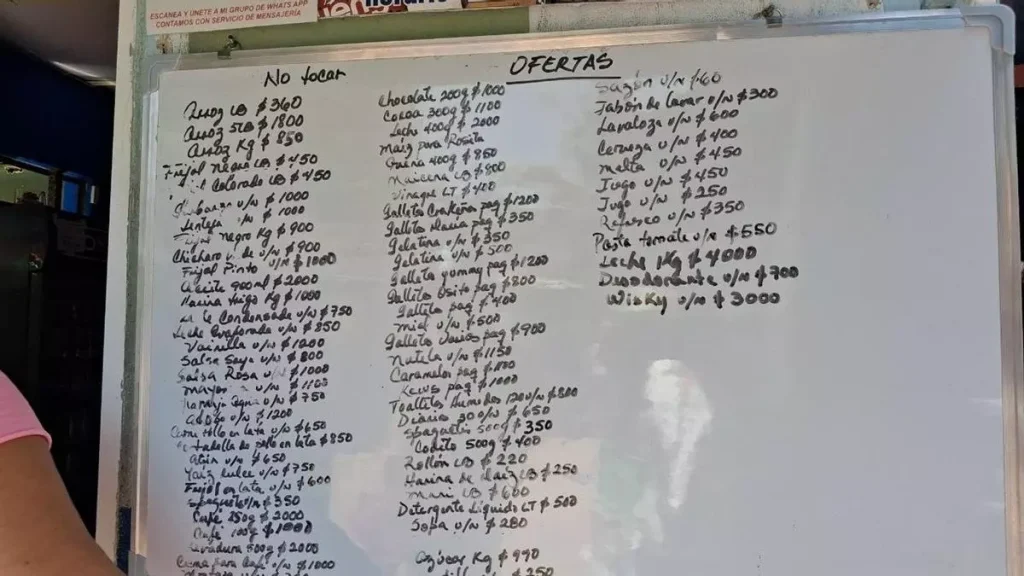
Looking at these numbers written on a whiteboard, you realize they’re not just prices. They’re decisions. Do I buy rice or oil? Do I get eggs or keep the money for transportation? / 14ymedio

14ymedio bigger14ymedio, Yoani Sánchez, Generation Y, 18 July 2026 / You don’t need an economic report or a table full of statistics. It’s enough to spend a few minutes looking at the blackboard in any market to understand how Cubans’ wallets are shrinking.

A pound of rice, that food that for decades was the centerpiece of the family table, now costs 360 pesos. Black beans reach 450 pesos. A kilogram of wheat flour exceeds 1,000 pesos. A carton of eggs is around 3,000 pesos, and a liter of vegetable oil surpasses 2,000 pesos.

Meanwhile, the average monthly salary in Cuba still does not reach 7,000 pesos.

Looking at these numbers written on a whiteboard, you realize they’re not just prices. They’re decisions. Do I buy rice or oil? Do I buy eggs or save the money for transportation? Do I cook beans today or continue reading

wait until next month?

A few years ago, finding a pound of rice for 360 pesos would have seemed absurd. Today, many people read that price, sigh, and hand their bag to the vendor.

Inflation is no longer a word reserved on this island for economists. It has the face of the mother counting her bills again before entering the store. Of the retiree walking around the block again, empty-handed. Of the worker who gets paid and, before the first week is over, discovers that his salary has already lost another battle.

Official data shows that prices rose again in June, particularly for food and transportation, while the increase in the informal market continues to accelerate. Accumulated inflation continues to erode the purchasing power of wages and pensions, and the feeling on the street is that prices are rising much faster than income.

The hardest part is that there are those who end up getting used to it.

A few years ago, finding a pound of rice for 360 pesos would have seemed absurd. Today, many people read that price, sigh, and hand their bag to the vendor. Our capacity for astonishment is also diminishing, our skin getting thicker in the face of everyday absurdity.

Perhaps it is this that the most worrying: inflation doesn’t just make food more expensive. It also erodes expectations, forces people to forgo nutritious foods, reduces portion sizes, and turns every trip to the market into a mathematical exercise in survival.

______________________

COLLABORATE WITH OUR WORK: The 14ymedio team is committed to practicing serious journalism that reflects Cuba’s reality in all its depth. Thank you for joining us on this long journey. We invite you to continue supporting us by becoming a member of 14ymedio now. Together we can continue transforming journalism in Cuba.

Cuban Professor Alina Bárbara López Announces She Will Expand Her Protests Following Her Detention This Saturday

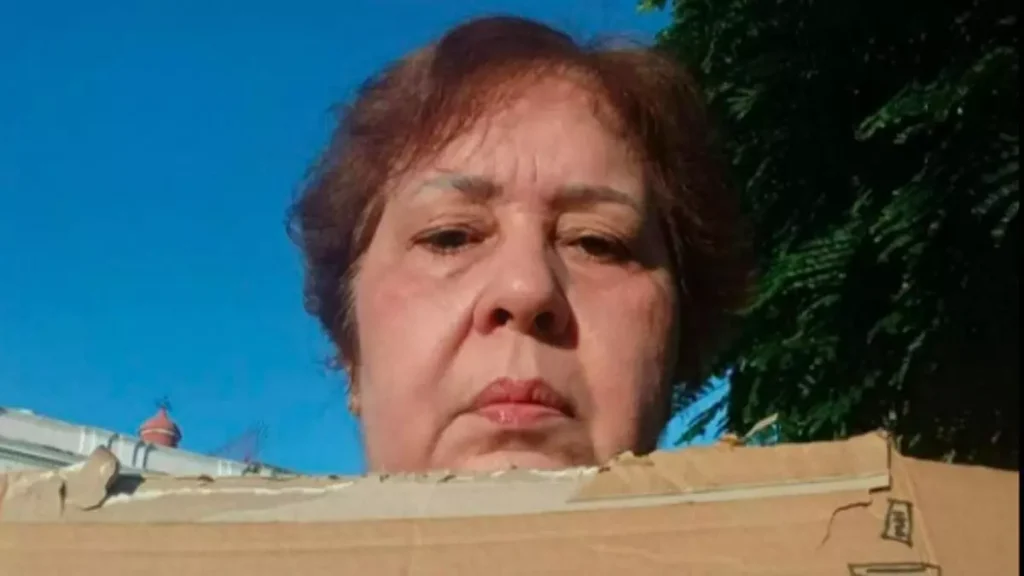
The professor denounced that her double arrest was a “kidnapping with no other possible interpretation.”

Alina Bárbara López has an open criminal case for “assault,” “contempt,” and “disobedience.” / Facebook

14ymedio bigger14ymedio, Havana, July 19, 2026 – Cuban professor and activist Alina Bárbara López Hernández announced the start of new protest actions after being detained twice this Saturday in Matanzas while attempting to carry out her peaceful demonstration held on the 18th of every month, as part of International Nelson Mandela Day. Through Facebook, the historian recounted what happened during the day and described the second arrest as “surreal” and a “kidnapping with no other possible interpretation.”

In the post, which she uploaded at night, hours after relatives, friends, and organizations reported her temporary disappearance during her first detention, López Hernández recounted that she was intercepted near the place where a police patrol usually waits for her and was taken to a police station, where she remained for five hours.

The professor explained that an investigating officer informed her that she would be issued a warning report for “violating the precautionary measure of house arrest” imposed as part of the criminal proceedings she faces alongside sociologist Jenny Pantoja. The academic said she refused to sign the document.

After being released, she once again tried to head to the park where she holds her monthly protests. “Half a block before arriving, the patrol car that has been guarding the Provincial Party headquarters full time since the events in Morón was alerted by a plainclothes State Security agent, and they were ordered to arrest me again,” she continue reading

recounted.

The very officer who had processed the warning report “was astonished” to see her detained again

Upon returning to the police station, she said, the same officer who had processed the warning report “was astonished” to see her detained again. “What are you doing here?” she asked. “Ask the patrol officers who brought me,” López Hernández replied. The officers later told her that she had to wait for someone from Counterintelligence who was going to “talk” with her, a meeting that, according to her, never took place. “I sat in the station lobby watching people who were victims of transfer scams and the theft of a solar lamp come in to file complaints,” she recounted.

“After about an hour, I said to her: ‘No one is coming to talk to me because the officers who give you your orders are cowards who don’t dare show their faces.’” Shortly afterward, the officer let her go: “Leave, I’m not going to keep you detained any longer.”

“The house arrest measure under case 40 serves them whenever it is convenient to detain me. To them, I am an object. And that’s not going to happen,” the activist emphasized in her message. The investigation López Hernández referred to is a criminal case the regime is pursuing against her and Jenny Pantoja on charges including “assault,” “contempt,” and “disobedience.” Prosecutors have requested four years in prison for López and three for Pantoja, but the trial, initially announced for last January, was postponed and has not taken place.

Prosecutors have requested four years in prison for López and three for Pantoja

In response, the professor announced a new phase of mobilizations. “I am going to begin nonviolent protests at the Municipal Court, the Prosecutor’s Office, the Party, the Government, and the State Security Operations headquarters. That trial will take place one way or another. They are going to put a free woman on trial, before, during, and after the trial,” she emphasized.

“They don’t want Jenny and me in prison because they would have to pay a high political cost, or perhaps they hope that if they keep pressuring us, we will also agree to leave Cuba. I can’t speak for Jenny, but I repeat to them: ‘If we have to suffer, we’ll suffer together, but from inside here,’” she warned at the end of her message.

So far in 2026, the activist has been systematically detained every time she has attempted to carry out her monthly protest: 12 hours in February, nearly 10 in April, and another 10 hours this past June.

Translated by Regina Anavy

______________________

COLLABORATE WITH OUR WORK: The 14ymedio team is committed to practicing serious journalism that reflects Cuba’s reality in all its depth. Thank you for joining us on this long journey. We invite you to continue supporting us by becoming a member of 14ymedio now. Together we can continue transforming journalism in Cuba.

“I’m Here To Continue Putting My Life on the Line”: Otero Alcántara Experiences His First Hours of Freedom After Leaving Cuba

Newly arrived in the US, the artist reconstructed a broken Virgin Mary statue he brought from the island and stated that Maykel ‘Osorbo’ would be in Miami “very soon” as well.

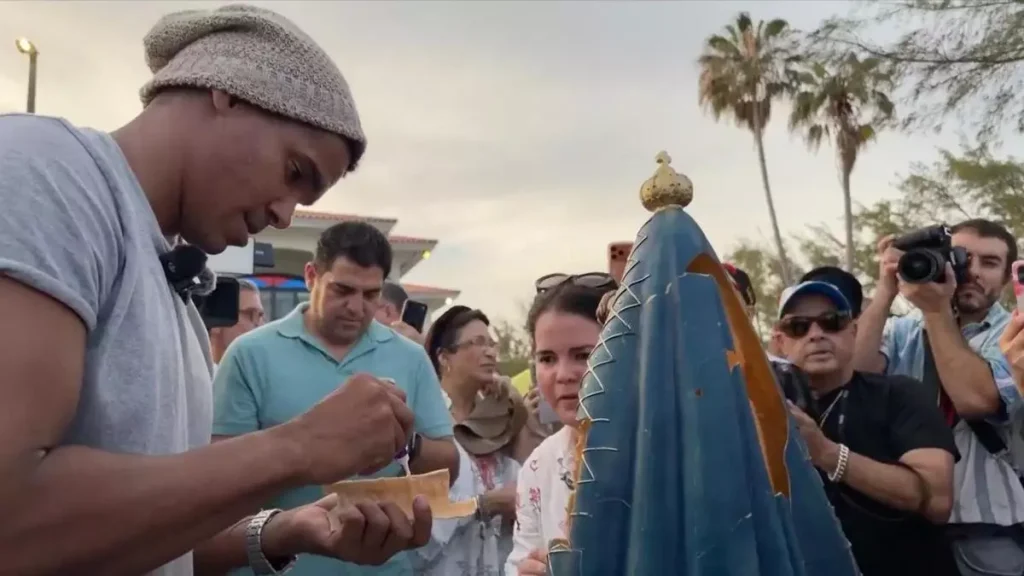
At the Shrine of Our Lady of Charity in Miami, Otero Alcántara restores a broken image of the Virgin Mary as a symbol of Cuba’s reconstruction. / Telemundo 51

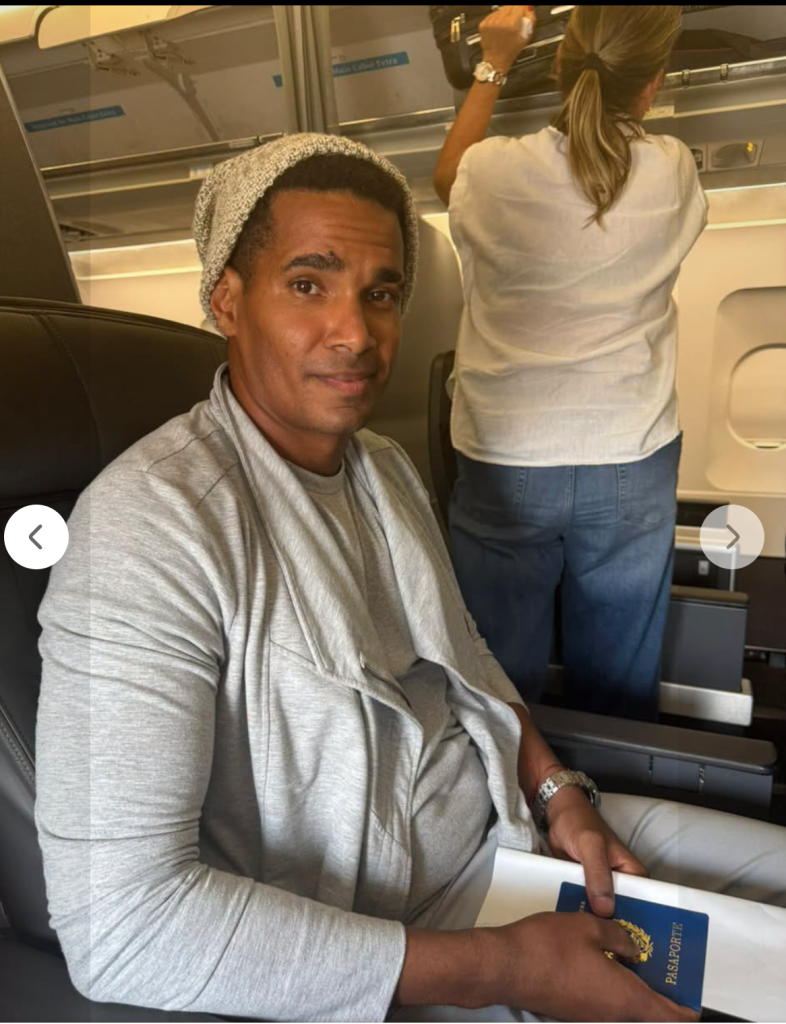
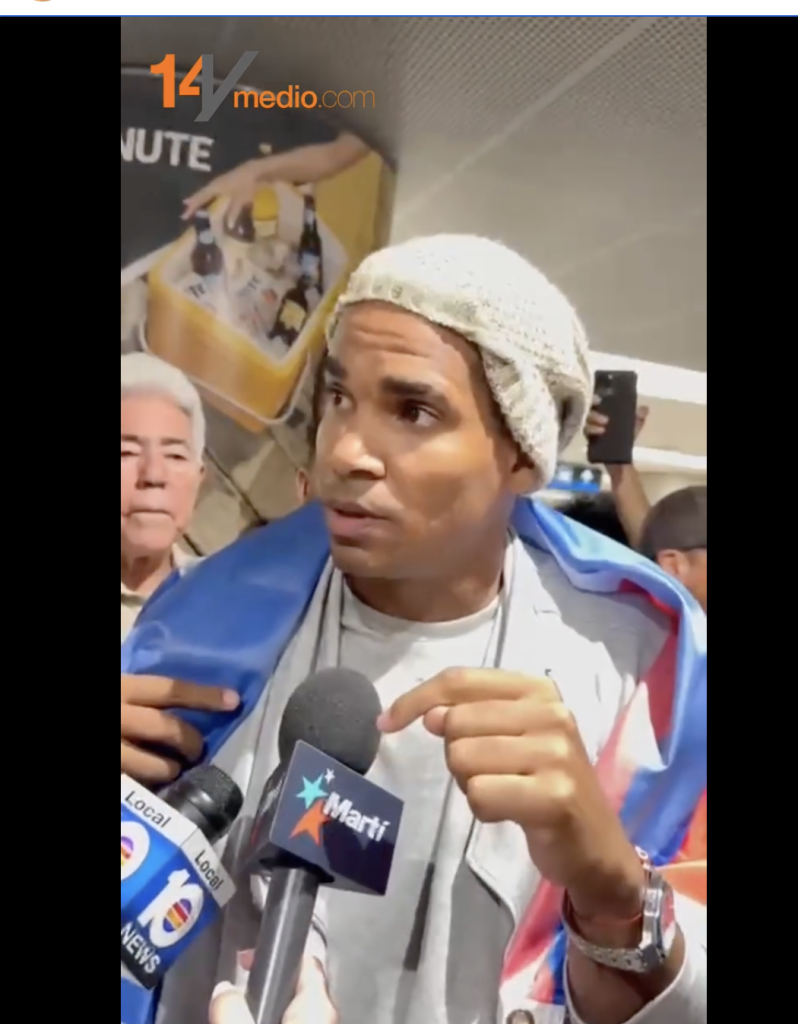
14ymedio bigger14ymedio, Madrid, July 19, 2026 — Just an hour after landing in Miami, USA, Cuban artist and former political prisoner Luis Manuel Otero Alcántara transformed his first act of freedom into a “spiritual and political” performance. At the Hermitage of Our Lady of Charity of El Cobre, before dozens of members of the exile community, journalists, and activists, he led an event to collectively reconstruct a broken image of Our Lady of Charity that he had brought from Cuba and presented as a metaphor for the “wounds” of the island, the exile community, and himself.

Faced with a barrage of questions from the press, Otero Alcántara repeatedly emphasized the same point: “What I want is to work. I’m here to work: every minute I waste is another minute of the dictatorship.”

Before beginning, he thanked the exile community for their support and dedicated a few words to the political prisoners who remain on the island, especially the rapper Maykel Osorbo Castillo Pérez, also a member of the San Isidro Movement. Regarding the musician, he stated that he would be in Miami “soon.” According to his contacts at the U.S. Embassy, ​​the artist could arrive in that country “in less than a month,” although he clarified that he couldn’t guarantee it. “Maykel is a survivor and a fighter, and if I survived, he’ll be alright, as far as possible.” continue reading

Regarding ‘Osorbo’, he stated that he would also be in Miami “very soon.” According to his contacts at the US Embassy, ​​the artist could arrive in that country “in less than a month.”

While applying glue to the fragments of the image, Otero Alcántara answered journalists’ questions. The artist reiterated that he will continue using art as a tool for political transformation: “There is a type of art that has the power to change things: a song changed things, a performance changed things,” he said, alluding to Patria y Vida and his own artistic actions on the island. But he insists that commitment is necessary, that art must be more than “a painting on the wall.” “I put my skin on the line, and I’m here to continue putting my skin on the line.”

He also sent a message to those who remain in Cuba. “We must continue fighting for freedoms, because it is possible.” Otero Alcántara maintained that “we must know what we are fighting for. We didn’t leave for chicken, for oil, or anything like that. We left demanding freedom, and freedom will bring all of that.”

The activist also claimed to have spoken with US Embassy officials about the situation of Cuban political prisoners. “They are putting pressure on,” he said, though he insisted that “to get them all out, the dictatorship must
be overthrown,” because “as long as the dictatorship exists, there will be political prisoners.”

“We need to know what we’re fighting for. We’re not out here for chicken, oil, or anything like that. We’re out here demanding freedom, and freedom will bring all of that.”

When asked about his time in prison, he said he felt “mentally healthier” thanks, in part, he said, to the international pressure exerted during those years. He explained that prison authorities allowed him to paint because they knew that this activity “kept him alive,” and he expressed his confidence in having been able to smuggle most of the artwork he created in prison out of the country.

He also announced that he is preparing a public exhibition of the more than 4,000 paintings he created during his imprisonment and managed to bring with him. He plans to hold an event where, as he unpacks them, he will talk about how he conceived them. “I’m going to keep making art; I have a lot of ideas in my head. All the works I’m bringing are about the feeling of confinement.”

Regarding the reconstruction of the Virgin of Charity statue, Otero Alcántara explained that it represents a meeting point for Cubans, transcending political or personal differences. “We are all broken,” he stated, alluding to families separated by exile and the consequences of repression. “The Virgin doesn’t restore herself. She is the culmination of all our collective energy.” He also maintained that spirituality is a space where “straight people, gay people, white people, black people, government supporters, dictators, State Security, opposition members, Mambises, and we, the artists,” all converge.

Otero Alcántara asserts that commitment is essential, that art must be more than just “a painting on the wall.” “I put my heart and soul on the line, and I’m here to continue putting my heart and soul on the line.”

While the performance was underway and many friends approached to embrace Otero Alcántara and celebrate his freedom, slogans such as “Patria y Vida” [Homeland and Life], “Down with the dictatorship,” and “Long live free Cuba!” were chanted. In addition, those present sang the Cuban national anthem.

The arrival of Luis Manuel Otero Alcántara in the United States generated immediate reactions both within and outside the Cuban exile community. U.S. Secretary of State Marco Rubio welcomed him with a statement declaring: “Luis Manuel Otero Alcántara faced years of repression and inhumane conditions under the Castro regime. His courage in appearing with the Cuban flag during ‘Patria y Vida,’ the anthem of freedom, inspired millions. It is a privilege to welcome him to the United States as a hero of the Cuban cause.” Rubio also called for the release of rapper Maykel Osorbo and the rest of the Cuban political prisoners, and reiterated the need for free elections on the island.

Republican Congressman Mario Díaz-Balart, for his part, maintained that Otero Alcántara and other opposition members “risked everything for the freedom of the Cuban people,” and reiterated his support for those who remain imprisoned for political reasons.

______________________

COLLABORATE WITH OUR WORK: The 14ymedio team is committed to practicing serious journalism that reflects Cuba’s reality in all its depth. Thank you for joining us on this long journey. We invite you to continue supporting us by becoming a member of 14ymedio now. Together we can continue transforming journalism in Cuba.

Luis Manuel Otero Alcántara Arrives in Miami in Forced Exile, After 11 Days of His Whereabouts Unknown

The artist was taken by the political police to Havana’s José Martí International Airport.

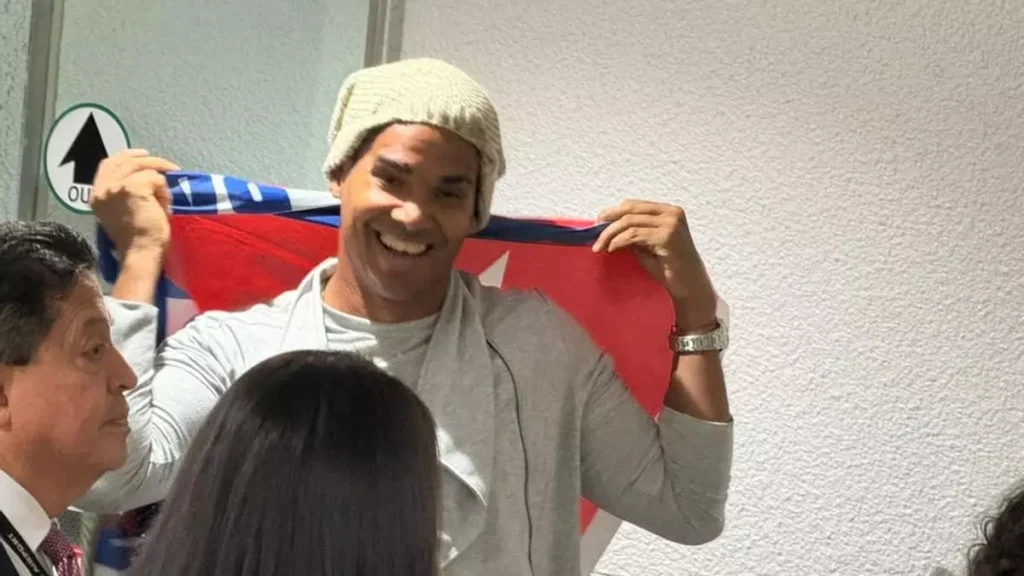
Otero Alcántara after arriving in Miami on July 18, 2026. / 14ymedio

14ymedio biggerLuis Manuel Otero Alcántara, artist and leader of the San Isidro Movement (MSI), who State Security kept in whereabouts unknown for 11 days, arrived in Miami this Saturday, one day after the United States granted him special permission (parole). A crowd of friends and supporters awaited him at the airport and greeted him by singing the Cuban national anthem.

In his first statements to the press, the artist recalled that “right now Maykel Osorbo is in prison” and asked the exile community in Miami, Cubans elsewhere, “Donald Trump,” “all those who can help us, please contribute to making Cuba free,” concluding: “that one minute of work is one minute less of dictatorship.”

After learning that the political prisoner had boarded a flight from Havana, the artist’s loved ones reported on social media that during his time in the Guanajay maximum-security prison, he “survived in an environment that deprived him of his freedom for political reasons, prevented him from fully developing his work, and separated him from the people he loves.” The regime’s repression did not extinguish Otero Alcántara’s fighting spirit: “Today he arrives with the profound desire to live again, resume his creative projects, and continue working for the freedom of Cuba.”

They also announced that, upon his arrival in Miami, the artist will visit the Shrine of Our Lady of Charity “to leave an offering of thanksgiving.” Otero Alcántara, they explained, “brings with him from Cuba a broken Virgin. Like many of us. Like Cuba. It is a gesture that invites us to gather the fragments, to piece together what has been broken, and to believe that it is still possible to continue reading

heal and recover a country that has been taken hostage.”

Right now Luis Manuel Otero Alcántara is flying to Miami International Airport, on flight AA2706. el aeropuerto internacional de Miami, en el vuelo AA2706. Right now ¡Luis Manuel está libre! Date: July 18 2026….

The Cuban state media was quick to report the artist’s departure, and in an article describing him as “the mercenary Washington is looking for,” asserts that Otero Alcántara has “a criminal record, not a record of conscience,” adding that “he is neither a political opponent nor a human rights defender. He is a common criminal, convicted by the Cuban justice system for crimes defined in our laws: contempt, public disorder, and desecration of national symbols.”

Otero Alcántara was taken by the political police to Havana’s José Martí International Airport in an escort similar to that provided to opposition figures José Daniel Ferrer and Luis Robles, “the young man with the flag,” both of whom were also released in exchange for accepting exile. In the case of the MSI leader, arrested on July 11, 2021—before he could participate in the massive demonstrations of that day—and sentenced to five years for the crimes of desecrating national symbols, contempt, and public disorder, he completed his sentence on July 9. However, by then, his family and friends did not know his whereabouts.

View video here.

Two days earlier, it was reported that the artist had been taken from the maximum-security prison in Guanajay, in the province of Artemisa, to an unknown destination. On July 9th, he contacted his friend Anamely Ramos, an art historian in exile and also a member of the MSI. According to a post by the activist herself on social media, Otero Alcántara called her “from a State Security cell phone, an unknown number, and the call was on speakerphone.”

When asked how he was, the artist replied “fine,” Ramos said, “with that tone we use to indicate that we’re doing as well as can be expected, given the circumstances.” He couldn’t answer the second question: “Where are you?”

The activist explained that the parole request for Alcántara to travel to the United States was “still in process” and that the artist would be “in that unknown location until it is resolved.” According to a U.S. official who spoke to 14ymedio on condition of anonymity, by confining Otero Alcántara after he had served his sentence, the Havana regime intended to “turn the tables on Washington and make it seem as though the artist was still detained due to the Trump Administration’s delay.”

His case, along with that of rapper Maykel Castillo Osorbo, became one of the emblems of the repression after 11J.

Years ago, both expressed their willingness to accept “prison in exile,” but at no point did they participate in the releases carried out by the regime.

Three days after Otero Alcántara’s release, Castillo was transferred to the Guanajay prison from Kilo 8, in Pinar del Río, where he was serving his sentence, in his case nine years.

Despite being arrested at different times, and not on April 4, 2021, the date of the events for which the regime accused Otero Alcántara, and May 18 of the same year for Osorbo, both Cuban artists share the same prosecution file, which is yet another example of the arbitrariness of revolutionary justice.

Declared prisoners of conscience by various international organizations, both have received numerous awards during their years in prison for their fight for human rights in Cuba. The most recent was the 2026 Democracy Award, granted by the National Endowment for Democracy (NED) last June.

They have also carried out several hunger strikes at different times and have denounced the prison conditions they endured. Years ago, both expressed their willingness to accept the “prison for exile” exchange, but at no point did they participate in the releases carried out by the Cuban regime through agreements with the Vatican, one in January 2025 , days before the end of Joe Biden’s presidency, and another last March .

______________________

COLLABORATE WITH OUR WORK: The 14ymedio team is committed to practicing serious journalism that reflects Cuba’s reality in all its depth. Thank you for joining us on this long journey. We invite you to continue supporting us by becoming a member of 14ymedio now. Together we can continue transforming journalism in Cuba.

Luis Goytisolo and the End of the Cuban Spell

The Spanish writer understood in 1971 that the imprisonment of Heberto Padilla was not an isolated mistake, but proof of the Revolution’s authoritarian drift.

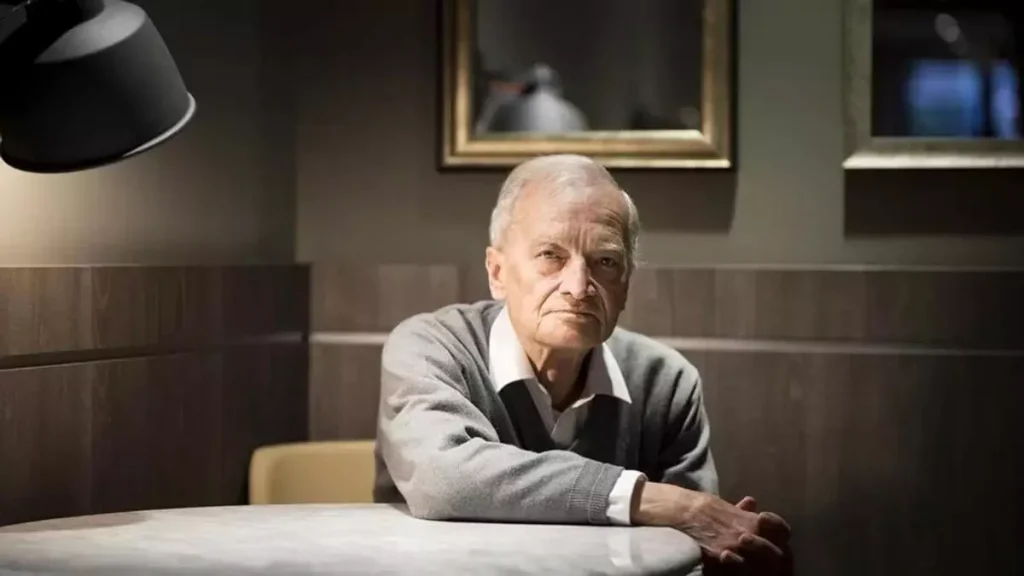
Luis Goytisolo, in a 2017 photograph. / EFE/Luca Piergiovanni

14ymedio bigger14ymedio, Noemí Herrera, Miami, July 18, 2026 – The death of Luis Goytisolo, who passed away this week at the age of 91, invites readers to revisit a monumental body of work such as Antagonía, one of the greatest achievements of 20th-century Spanish-language fiction. An experimental writer, member of the Royal Spanish Academy, and a pioneer of contemporary narrative, Goytisolo leaves behind a literary legacy of enormous significance. But from Cuba, it is also worth remembering another aspect of his life, less frequently mentioned in obituaries and yet essential to understanding the intellectual history of the second half of the 20th century.

Luis Goytisolo was one of the writers who helped dismantle the immense moral prestige that the Cuban Revolution had accumulated among the European left. He was not the only one, nor even the most visible. But he was there when part of the intellectual community decided that the time had come to stop justifying the unjustifiable. His background included coming from a family of businessmen of Basque origin who made their way in Cuba, the Island that would once again cross his path.

Luis, by contrast, cultivated a more reserved profile, focused on literature and less inclined toward public exposure

It is important to distinguish between the brothers. Juan Goytisolo occupied a singular place in Spanish literature for decades and became a much better-known public figure internationally, especially because of his constant confrontation with the Franco regime and his cosmopolitan life. Luis, by contrast, cultivated a more reserved profile, focused on literature and less inclined toward public exposure. That difference in temperament has often led people to confuse the two when discussing the so-called Padilla Affair. However, both actively participated in the protest that permanently changed the relationship between much of the European intellectual community and Fidel Castro’s continue reading

regime.

Until 1971, the Cuban Revolution enjoyed extraordinary prestige within Western cultural circles. The romantic image of the Sierra Maestra continued to captivate writers, philosophers, and artists who saw Cuba as an ethical alternative to capitalism and the Latin American dictatorships. The Island was the laboratory where many wanted to believe a form of socialism different from the Soviet model could be built.

The imprisonment of poet Heberto Padilla shattered that illusion.

His “crime” had been writing uncomfortable verses and expressing criticism of the revolutionary bureaucracy. His arrest, followed by that humiliating public confession at the headquarters of the Union of Writers and Artists of Cuba (Uneac), a scene that evoked the Stalinist show trials, caused a moral earthquake among those who still defended the Cuban Government.

The Goytisolo brothers also participated in drafting a second letter, far more forceful, which openly denounced the regime’s authoritarian drift

It was then that the first open letter addressed to Fidel Castro and published by Le Monde appeared. Among its organizers and signatories were Juan and Luis Goytisolo, together with such prominent figures as Jean-Paul Sartre, Simone de Beauvoir, Mario Vargas Llosa, Susan Sontag, Alberto Moravia, Carlos Fuentes, and Octavio Paz. They called for the poet’s release and warned that imprisoning a writer for expressing his ideas was incompatible with the emancipatory project that Cuba claimed to represent.

Padilla’s release resolved nothing. On the contrary. The spectacle of his public self-criticism deepened the scandal. That forced confession, in which the poet accused himself and denounced colleagues and friends, was far too reminiscent of the old Moscow trials. The Goytisolo brothers also participated in drafting a second letter, far more forceful, which openly denounced the regime’s authoritarian drift. For many cultural historians, that second document marks the true breaking point between the Cuban Revolution and a fundamental part of the Western democratic intellectual community.

Fidel Castro’s reaction was as predictable as it was revealing. The signatories ceased to be fellow travelers and became traitors, agents of imperialism, or victims of bourgeois manipulation. Cuba’s doors began to close to many of them. The so-called “Five-Year Gray Period” consolidated a cultural policy based on suspicion, ideological surveillance, and political obedience.

He was a writer who understood that there comes a moment when silence ceases to be a form of prudence and becomes a form of complicity

For decades, official propaganda attempted to minimize that rupture. It portrayed the Padilla Affair as a foreign conspiracy and turned critical intellectuals into personal enemies of the Revolution. Yet the damage was irreversible. Not because Cuba lost a handful of prestigious visitors, but because it lost something far more difficult to recover: the moral authority that had captivated much of the international progressive intelligentsia.

It is significant that Luis Goytisolo did not build a testimonial monument around that episode. He remained, above all, a novelist. He continued writing, experimenting with narrative forms, and producing a body of work whose summit is Antagonía, that extraordinary exploration of consciousness and of the very act of writing, which occupies a privileged place in contemporary Spanish literature.

Perhaps that is precisely why his role in that rupture deserves to be remembered today. He was not a professional activist or a permanent polemicist. He was a writer who understood that there comes a moment when silence ceases to be a form of prudence and becomes a form of complicity.

Today, more than half a century after the Padilla Affair, it is difficult to imagine the impact of those letters. They did not change the fate of the Cuban Revolution. Nor did they prevent the consolidation of the cultural apparatus that for decades punished dissent. But they did transform something equally important: they brought innocence to an end. After 1971, it was no longer possible to claim that no one knew. The spell had been broken. And Luis Goytisolo, together with his brother Juan and so many others, helped break it.

Translated by Regina Anavy

______________________

COLLABORATE WITH OUR WORK: The 14ymedio team is committed to practicing serious journalism that reflects Cuba’s reality in all its depth. Thank you for joining us on this long journey. We invite you to continue supporting us by becoming a member of 14ymedio now. Together we can continue transforming journalism in Cuba.

“Ice Cold,” Cuba’s New Luxury

In a Havana battered by power outages lasting more than 24 hours, offering a chilled drink has become a commercial oasis.

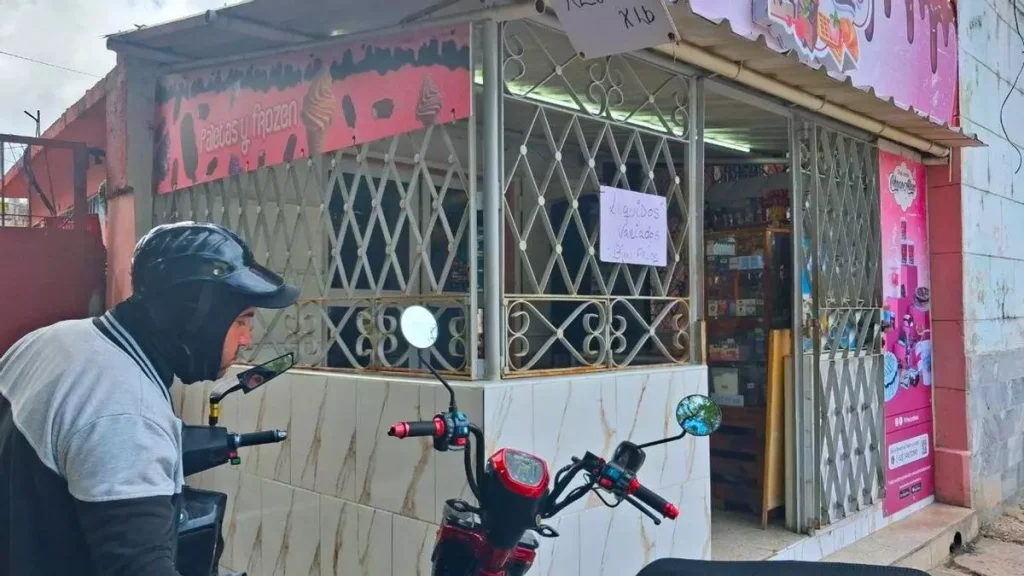
Store signs used to advertise “special offers,” “combos,” or “new arrivals.” Now, simply writing “ice cold” is enough to attract customers. / 14ymedio

14ymedio bigger14ymedio, Natalia López Moya, Havana, July 17, 2026 – By mid-morning, the stretch of Ayestarán where the Choco Alexo pastry shop is located looks like an island in the middle of the desert. While most businesses in the neighborhood have kept their refrigerators turned off after more than 24 hours without electricity, a handwritten sign hangs above the entrance with a message that would have seemed unnecessary just a few years ago: “Assorted beverages, ice cold.”

It does not advertise a sale or a discount. It promises something far scarcer.

In Cuba, where endless blackouts have become the norm, a cold drink has become an everyday luxury. What was once an insignificant detail—a beer just taken out of the refrigerator, a soft drink with condensation covering the bottle, or a glass of water with ice—is now reason enough to stop in front of a store and ask whether anything cold is still available.

Buying a package of chicken quarters means feeling the plastic wrapping in several places to check whether the meat is still firm or has already begun to thaw, releasing the sticky liquid that eventually soaks the bag and your hands. The same happens with hot dogs, hamburgers, and ground meat, not to mention ice cream. continue reading

Owners calculate every minute their refrigerators can run so they do not drain their batteries or run out of fuel for their generators

In many privately owned cafés, coffee is still served hot because it only takes a gas stove to prepare it, but ordering a soft drink that is not at room temperature has become almost an act of optimism. Owners carefully calculate every minute their refrigerators can operate so they do not exhaust their batteries or generator fuel. Others have simply given up offering products that need to be kept cold.

The shortages have even changed the language of advertising. Store signs used to promote “special offers,” “combos,” or “new arrivals.” Now, simply writing “ice cold” is enough to draw customers. What is extraordinary is no longer the product itself, but the temperature at which it has managed to stay.

The energy crisis has literally made everyday life hotter.

In another neighborhood, far from Ayestarán Street, a group of boys had just finished a game of street soccer under the blazing sun. Sweaty, with their shirts clinging to their bodies and their knees covered in dust, one of the children shouted loudly enough for the whole block to hear: “I want a little cup of water with ice!” He was not asking for an imported soft drink, a malt beverage, or an energy drink. Just water. Water with ice. He said it with such heartbreaking longing that several people looked up from their front porches.

No one answered. Everyone knew that such a modest wish could be just as difficult to fulfill as any other luxury.

Translated by Regina Anavy

______________________

COLLABORATE WITH OUR WORK: The 14ymedio team is committed to practicing serious journalism that reflects Cuba’s reality in all its depth. Thank you for joining us on this long journey. We invite you to continue supporting us by becoming a member of 14ymedio now. Together we can continue transforming journalism in Cuba.

Residents of Sancti Spíritus, Cuba, Donate More Than $10,000 to Etecsa to Buy Solar Panels

Residents of Zaza del Medio raised the money to restore communications to the town during the blackouts.

The blackouts kept the residents of Zaza del Medio, in Taguasco, Sancti Spíritus, cut off from communication almost all the time. / 14ymedio

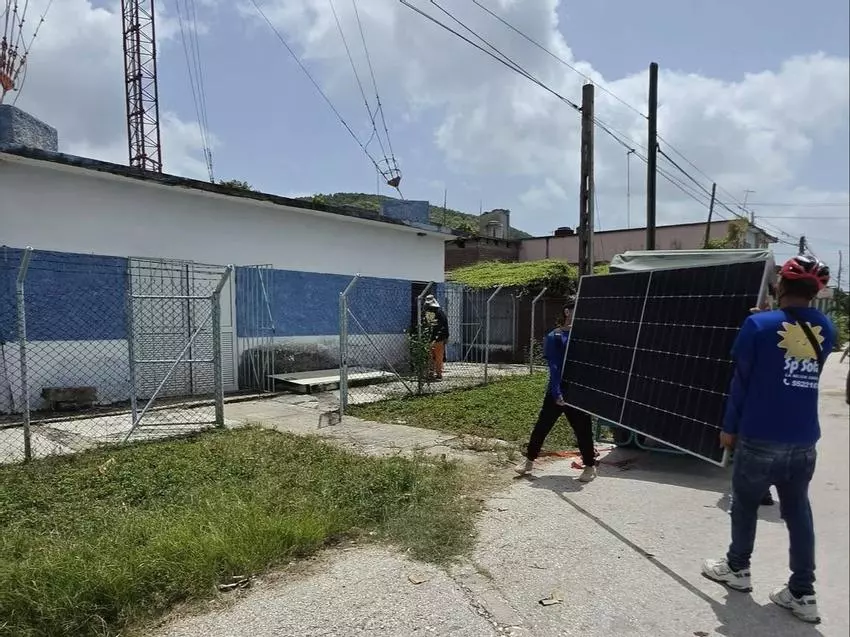
14ymedio bigger14ymedio, Mercedes García, Sancti Spíritus, July 18, 2026 – Faced with the lack of internet access, a group of residents raised $10,300 and 26,000 Cuban pesos to purchase solar panels and the rest of the photovoltaic kit needed to power the local radio base station of the state-owned telecommunications company Etecsa in the town of Zaza del Medio, in the municipality of Taguasco, Sancti Spíritus. The blackouts left residents cut off from communication almost all the time, as electricity returned for only a couple of hours between outages that could last more than a day.

According to residents, the initiative had its critics, who questioned why the residents themselves had to finance a state-owned company known for its abusive prices, poor service quality, and role in the government’s control of the internet. Even so, they raised the money to restore connectivity, above all so they could communicate with family members living abroad.

Installation of solar panels at Etecsa’s mobile radio base station in Zaza del Medio. / Radio Sancti Spíritus

The official press, however, in reporting on the installation of the photovoltaic system at the town’s radio base station, avoids explaining that the initiative originated with the residents themselves. The most it acknowledges is that “through a fundraising campaign carried out through different channels, all the financial support needed to obtain the solar panels was collected,” according to Luis Orlando Gómez Castro, president of the People’s Council, in statements to Radio Sancti Spíritus.

The official also admitted that much of the funding came from relatives living abroad: “We want to recognize those who, even from abroad, with Cuban blood still running through their veins, contributed the financial continue reading

support that was needed to restore communications in Zaza del Medio.”

“We want to recognize those who, even from abroad, with Cuban blood still running through their veins, contributed the financial support that was needed to restore communications in Zaza del Medio”

The state-run outlet acknowledges that the local government did not have the budget to finance “such a costly investment,” and while it highlights “the importance of public participation in securing the necessary funding,” it omits explaining where the initiative originated and how much money was contributed by the customers of a company that will continue charging them rates far above international standards for one of the worst internet services in the world.

Etecsa, Cuba’s only telecommunications operator, maintains a monopoly over telephone and internet services on the Island and is controlled by the military conglomerate Gaesa. The company has been the target of constant criticism for the poor quality of its services, its high prices, and its role in censorship and content filtering, as it is subordinated to the regime’s priorities rather than the needs of its customers. Numerous independent media websites and organizations critical of the Government remain blocked on its network, and users in Cuba can access them only through VPNs.

During periods of heightened political tension, the company has carried out Government orders to restrict internet access and block communications, as occurred during the massive protests of July 11, 2021, as well as through the selective blocking of the telephone lines of activists and opposition members.

Translated by Regina Anavy

______________________

COLLABORATE WITH OUR WORK: The 14ymedio team is committed to practicing serious journalism that reflects Cuba’s reality in all its depth. Thank you for joining us on this long journey. We invite you to continue supporting us by becoming a member of 14ymedio now. Together we can continue transforming journalism in Cuba.

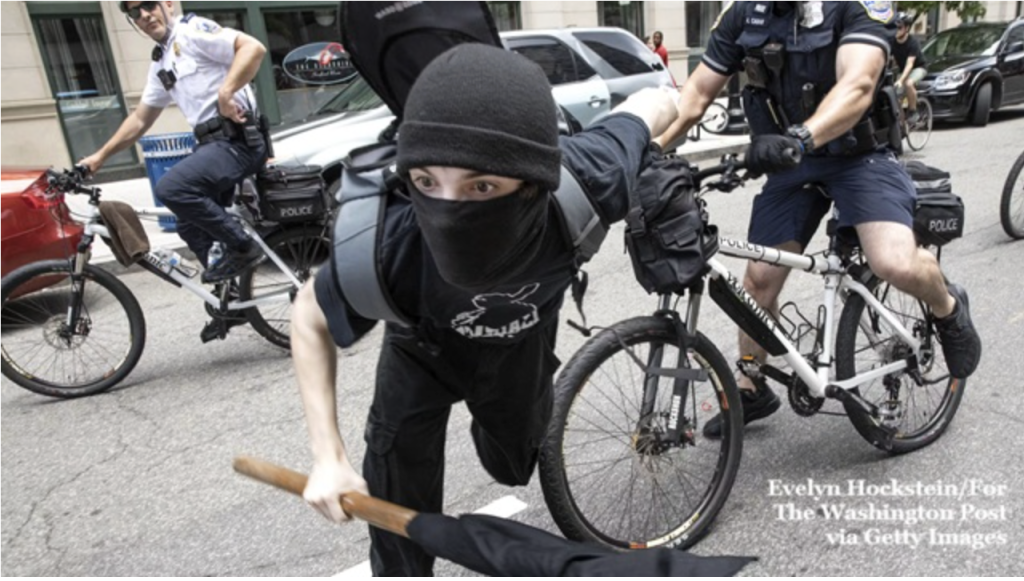
America Reawakens: Combatting the Far-Left Threat

America Reawakens: Combatting the Far-Left Threat

The CubanAmerican Voice, Julio M. Shiling, Jul 17, 2026 / In a landmark address before representatives from more than 70 countries at the U.S. State Department’s Ministerial Conference on the Resurgence of Political Terrorism on July 16, 2026, Secretary of State Marco Rubio delivered a clarion call. This marks a decisive shift in American foreign and domestic policy. The United States, Rubio declared, is formally committing to combat far-left extremist movements that have long endangered Western civilization and the American republic itself. For too long, terrorist and violent activities rooted in ideological extremism have received a troubling pass, shielded by sympathetic narratives in media, academia, and elite institutions. That era of indulgence is ending.

Rubio’s speech was both diagnostic and prescriptive. He emphasized that Marxist-inspired groups are not fringe actors operating in isolation but components of a sophisticated, well-coordinated international network dedicated to advancing variants of socialism and undermining democratic societies. Central to this network, Rubio noted—reminding his audience pointedly more than once—is the communist regime in Cuba. For decades, Havana has served as a hub for radical left-wing terrorism, recruiting, training, and backing Marxist and Third-Worldist movements across the hemisphere and beyond. Its “sprawling intelligence and ideological network” helped build the far left in the United States and remains inextricably linked to far-left groups and movements within and beyond the West.

This announcement represents a welcome structural offensive by America against communism’s ongoing war on the West. In many respects, it revives a policy approach that proved largely successful during the Cold War. From the outset of that existential struggle, the United States recognized the subversive threat posed by Soviet and allied forces. Castro’s Cuba stood at the forefront of this assault, exporting revolution through terrorist training camps that prepared continue reading

tens of thousands of Marxist guerrillas. Groups like the FARC, ELN, Tupamaros, Montoneros, Italy’s Red Brigades, and Germany’s Red Army Faction embodied the violent edge of this ideology. The West confronted these threats with resolve, intelligence cooperation, and ideological clarity.

Tragically, that vigilance waned with the fall of the USSR. A wave of triumphalism led to the mistaken belief that history had ended and that economic liberalization would inevitably produce democracy everywhere. The West, particularly under policies encouraging China’s integration into global markets, bet that market mechanisms would tame communism. That wager failed spectacularly. The Chinese Communist Party adapted, retaining totalitarian control while exploiting global trade. Meanwhile, Marxism reinvented itself through cultural and ideological channels rather than purely economic ones.

Intellectual architects like Antonio Gramsci and the Frankfurt School provided the blueprints. Gramsci’s concept of cultural hegemony urged revolutionaries to capture institutions—education, media, arts, and civil society—rather than seizing state power through confrontation alone. The Frankfurt School’s critical theory dissected Western society as inherently oppressive, laying groundwork for postmodern critiques that eroded confidence in objective truth, tradition, and national identity. These ideas flourished in the late 20th and early 21st centuries, finding expression in identity politics revolutionaries who rebranded themselves as antifascists, radical environmentalists, anticapitalists, and globalists. In some cases, these currents have even blended with strains of Islamic jihadism, creating hybrid threats that exploit grievances under the banner of “liberation.”

The result has been a sustained incursion into the cultural and political fabric of the West. What began as academic theory manifested in street-level violence, institutional capture, and policies that prioritize division over cohesion. Antifa networks, operating transnationally with encrypted coordination and shared propaganda, exemplify the modern face of this challenge. Rubio highlighted rising far-left violence in Europe, including a more than 40% increase in Germany and the dominance of extreme-left actors in Greek radical incidents. In the U.S., designations of violent far-left groups as Foreign Terrorist Organizations, alongside new sanctions on Cuban entities like the Ministry of the Revolutionary Armed Forces (MINFAR), the Cuban Institute of Friendship with the Peoples (ICAP), and others, signal concrete action.

This 21st-century policy reset arrives at a propitious moment. The Trump administration appears poised to advance regime change efforts in Cuba. Addressing this longstanding source of regional instability and ideological export is crucial. By targeting the financial and operational lifelines of these networks—through sanctions, intelligence sharing, law enforcement workshops (with the next co-hosted by Germany), and Rewards for Justice programs—the U.S. is rebuilding the infrastructure of victory.

Critics may decry this as partisan overreach or an exaggerated threat. Yet history and evidence tell a different story. From Shining Path’s atrocities in Peru to the Red Brigades’ executions and contemporary Antifa-linked disruptions, far-left extremism has consistently cloaked resentment and destruction in the language of justice and equality. Rubio captured it powerfully: it is “a poisonous resentment… an overwhelming need to tear down what greater men have built.” Far-left actors despise the West precisely because of its greatness—its prosperity, freedoms, and achievements.

America’s re-adoption of an assertive stance against these forces is not merely defensive; it is a reaffirmation of civilizational confidence. By forging coalitions across Europe, Latin America, and Asia, even amid skepticism from some allies accustomed to downplaying the threat, the U.S. is leading as it did in the Cold War. The battle is ideological as much as operational. It demands clarity about the incompatibility of Marxist-derived frameworks with individual liberty, rule of law, and human flourishing.

As Secretary Rubio’s address underscores, the United States will no longer tolerate radical Marxist regimes and their proxies exporting subversion. This offensive posture, linking historical lessons to present dangers, offers hope that the West can reclaim the initiative. The stakes could not be higher: the preservation of the civilization that has delivered unprecedented liberty and progress against ideologies that have repeatedly delivered tyranny and ruin. In confronting this networked challenge head-on, America signals that it stands ready once more to defend the principles that define it.

The Most Difficult Journey for Doctors and Nurses Begins When the Shift Ends

The transportation crisis and blackouts turn the trip home into another shift of endurance for healthcare workers in Matanzas

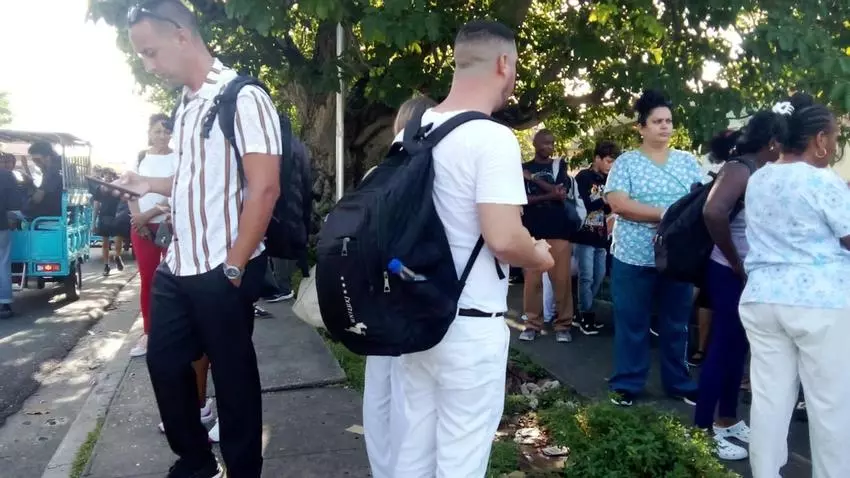
The bus designated to transport healthcare workers to different municipalities in the province should have already picked up the staff from the Maternity, Pediatric, and Faustino Pérez hospitals. However, no one knows when it will arrive.

14ymedio bigger14ymedio, Julio César Contreras, Matanzas, July 18, 2026 / At 10:30 in the morning, the sun is already beating down on the Versalles neighborhood, and the shade of a leafy tree becomes the busiest waiting room in the Public Health system in Matanzas. There, on a concrete wall, doctors, nurses, and technicians rest with the same posture as someone who has been awake far too long. Some have taken off their shoes to relieve swollen feet after 24 hours on shift. Others hold their mobile phones, hoping for news about a bus that should have left a while ago and which, once again, is nowhere to be seen.

The white coats are still on, but they are no longer a symbol of medical authority – only of exhaustion.

The bus meant to carry healthcare workers to different municipalities in the province should already have picked up staff from the Materno, Pediátrico, and Faustino Pérez hospitals. Yet no one knows when it will arrive. The scene repeats so often that few are surprised anymore. Only the level of accumulated exhaustion changes. continue reading

The delay is “a mess” that happens practically every week, one the authorities seem to have grown accustomed to ignoring

Maricela, a nurse with 31 years of experience, watches the clock with a mixture of resignation and indignation. She says the delay is “a mess” that happens practically every week, one the authorities seem to have grown accustomed to ignoring.

“Given how critical the transportation situation is, this is the only way to manage it for those of us who depend on a salary. I’m about to request a transfer to the Jovellanos Polyclinic, because with this uncertainty over whether the bus will come or not, it’s impossible to work,” she tells 14ymedio. The hours without sleep are still visible on her face.

Around her, the conversations all turn on the same subject. They are not talking about diagnoses or patients, but about missed schedules, endless routes, and broken promises. One nurse absent-mindedly checks a backpack full of belongings; another fans herself with a yellow folder while calculating how long it will take her to get home.

“Those of us who work at the Materno never know what time in the morning we’ll get out of here. It’s at our own risk,” Maricela sums up. For many, the problem doesn’t end once the bus finally shows up. A doctor who makes the trip to Limonar twice a week says the journey has become a real ordeal.

“This very day, if the bus doesn’t come soon, I’ll have to go to the taxi stand at the terminal. It’s 2,000 pesos to Jagüey Grande, an amount I can’t afford to pay more than once on my salary.” / 14ymedio

“At the hospitals themselves, there are already people off the street who, without any shame, ride comfortably seated, while those of us who are supposed to be the ones benefiting from the service have to stand, packed in like sardines,” he says. According to him, the vehicle makes stops all along the way to pick up private passengers who pay the drivers directly.

“It picks up anyone it comes across, with backpacks, sacks, or goods. Their business is pocketing the money, without caring that the contract between Public Health and Ómnibus Transmetro was meant to meet our needs, not create more problems,” he complains.

When he manages to get on, he knows he will probably spend much of the trip standing by the door, surrounded by bags and bundles that other passengers are carrying to sell in rural communities.

Breakdowns, fuel shortages, and blackouts affect the operation of state transportation and end up extending the workday well beyond official hours. After a night attending to births, pediatric emergencies, or critical patients, many healthcare workers must spend several additional hours simply getting home, or be prepared to pay a private driver to take them.

Not even Elena, a well-known nurse who has completed three international missions, can hide the discouragement and indignation the transportation crisis causes her.

“After a shift full of hardships, we don’t even have safe transportation to get back to our towns. That’s the bare minimum the Government should guarantee.”

“I’m going to do everything I can to keep just one shift a month whose departure isn’t on a Monday or a Friday, because those are the most difficult days to get transportation,” she says. She explains that many professionals from outlying municipalities no longer want to work at the provincial hospitals precisely because of the uncertainty of getting home.

“After a shift full of hardships, we don’t even have safe transportation to get back to our towns. That’s the bare minimum the Government should guarantee.”

Her motivation, she admits, has been wearing thin from all the waiting.

More than once she has thought about requesting leave and looking for any other job that would let her earn more money and live with less frustration.

She always carries cash in her purse in case she has to resort to private transportation. “Thanks to my husband, who’s self-employed,” she clarifies.

“This very day, if the bus doesn’t come soon, I’ll have to go to the taxi stand at the terminal. It’s 2,000 pesos to Jagüey Grande, an amount I can’t afford to pay more than once on my salary. If I do, how do I make it to the end of the month?”

The question hangs unanswered beneath the trees of Versalles. No one responds. Perhaps because everyone already knows the answer. It is the same one that has led so many doctors and nurses to hang up their white coats for good, worn out not only by the shortages inside the hospitals, but also by the endless wait, week after week, for a bus that almost never arrives on time.

Translated by GH.

______________________

COLLABORATE WITH OUR WORK: The 14ymedio team is committed to practicing serious journalism that reflects Cuba’s reality in all its depth. Thank you for joining us on this long journey. We invite you to continue supporting us by becoming a member of 14ymedio now. Together we can continue transforming journalism in Cuba.

Cuba: What ‘El Cangrejo’ Can Never Want

What Raúl Guillermo Rodríguez Castro fails to understand is something extremely basic and obvious: to desire ‘the people’ to live as he does, if taken seriously, requires the disappearance of the system that sustains his luxuries

Raúl Castro and his grandson, Raúl Guillermo Rodríguez, ‘El Cangrejo’, in a photo from 2009. / EFE / Alejandro Ernesto

14ymedio bigger14ymedio, Montreal, Karel J. Leyva, July 18, 2026 / Raúl Guillermo Rodríguez Castro (known as El Cangrejo, ‘The Crab’),  Raúl Castro’s grandson, dressed in Hugo Boss, Hermès, and a steel Rolex, recently told USA Today that it pains him that the Cuban people cannot live as he does.

Criticism of his hypocrisy was not long in coming: a “revolutionary” who not only lives in luxury but flaunts it openly while the people live in the most abject misery; a mere bodyguard with communication difficulties who feels he is helping to improve the situation of a country destroyed and plunged into darkness by his most admired figures, whose initials he has engraved on his gold medallion.

Beyond the heir’s tasteless joke, beyond the moral lapse, beyond the deep revulsion his cynicism provoked, his “pain” reveals a paradox that perhaps not even he manages to grasp.

El Cangrejo does not live well despite Cuba living badly: he lives well because Cuba lives badly

El Cangrejo does not live well despite Cuba living badly: he lives well because Cuba lives badly. The misery, hunger, and darkness of the Cuban people, their physical and moral deterioration, are the very condition that makes his opulence possible. The same apparatus that lets him carry classified reports in a Ferragamo briefcase while plundering the country is the one that produces the shortages El Cangrejo claims to lament. continue reading

Beyond his absurd assumption (that it pains him that the people don’t wear Rolexes and thousand-dollar sneakers, as if that were the people’s aspiration, as if that were the standard by which to judge a nation’s wellbeing, as if his lifestyle were the measure of all things, as Protagoras would say), what El Cangrejo fails to understand is something extremely basic and obvious: wanting the people to live as he does, taken seriously, requires the disappearance of the system that sustains his luxuries and those of the entire elite that controls the country.

His “it pains me” is, in fact, a phrase with no possible referent: it points to no world that Rodríguez Castro could coherently want. And yet he said it, in an interview he gave while explicitly positioning himself as a spokesman representing the interests of the Cuban nation.

More than a confession of double standards, El Cangrejo was trying on the suit of a presentable successor before the only audience that today decides whether Cuba has a democratic transition or merely an inheritance. The message, translated, is: here is someone you can negotiate with, without touching the apparatus of oppression.

The people do not need to live like El Cangrejo. They need the system of privilege that sustains his luxuries to disappear, while millions of Cubans barely manage to survive amid scarcity

One could argue that he is at least more honest than some of his relatives, who are always in olive-green uniform, always denying their privilege, while he displays his to the entire world without the slightest remorse. But his stance is either a public-relations technique or simply the carelessness of someone accustomed to feeling and appearing superior to the rest of Cubans for the sole fact of having been born into the family that has oppressed them for decades.

If it truly pains him that the people don’t live as he does, is he willing to stop living as he lives? If his pain is genuine, would he sell his belongings to ease the hunger of the elderly, to buy electric generators? Would he sell his thick gold chain, his sneakers from the luxury French house Hermès, or his Ferragamo briefcase to relieve, even slightly, that pain? Would he also give up everything he would never dare show in front of a camera?

But there is a prior question, and a more fundamental one — the only one that determines whether his pain is sincere: would he renounce the apparatus itself (the conglomerate, the command, the place he occupies by blood rather than merit), would he accept ceasing to be the “presentable candidate,” would he give up the succession he so covets, and above all, would he disappear from the sight of Cubans forever?

The people do not need to live like El Cangrejo. They need the system of privilege that sustains his luxuries to disappear, while millions of Cubans barely manage to survive amid scarcity. But if that system disappeared, so too would the conditions that produced El Cangrejo. And that, precisely, is what El Cangrejo could never want.

Translated by GH

______________________

COLLABORATE WITH OUR WORK: The 14ymedio team is committed to practicing serious journalism that reflects Cuba’s reality in all its depth. Thank you for joining us on this long journey. We invite you to continue supporting us by becoming a member of 14ymedio now. Together we can continue transforming journalism in Cuba.